Choosing PRP Tubes for a Clinic - What to Look For
Anticoagulant, separator gel, single or double spin, blood volume, sterility and regulatory status: what the literature says and what to ask any PRP tube supplier.
- Reading time
- 11 min read
- Author
- Estebien Editorial Team
In short
- Choosing a PRP tube comes down to five questions: which anticoagulant, whether there is a separator gel, single or double spin, how much blood the tube takes, and what sterility and regulatory documents come with it.
- The 2021 PRP recommendations of the Indian dermatology association IADVL prefer ACD-A as the anticoagulant, but all the studies it reviewed found both ACD-A and sodium citrate acceptable.
- The same recommendations favour a double spin and give a target platelet concentration of 1-1.5 million per microlitre for dermatology; the ISHRS says there is no consensus on the ideal concentration.
- Classification systems such as PAW, DEPA, PLRA and MARSPILL exist for PRP, but according to a 2021 review none has been validated by international consensus.
- A tube's anticoagulant, volume, gel content, sterilisation method and documents belong on the packaging or in the supplier's written information; do not assume a property, ask.
For a clinic, the right PRP tube is one whose supplier states clearly which anticoagulant it contains, whether it has a separator gel, how many spins it is meant for, how much blood it takes and which sterility and regulatory documents come with it. According to the literature, each of these variables changes the platelet count and purity of the plasma, but there is no single standard protocol. This article brings together published recommendations and the questions to put to any supplier.
What is a PRP tube, and how does it differ from an ordinary blood tube?
A PRP tube is the container in which the patient's blood is collected with an anticoagulant that stops it clotting, and then separated into layers in a centrifuge. According to the ISHRS, three products result: red blood cells, platelet-poor plasma (PPP) and platelet-rich plasma (PRP). The general steps are in our guide to what PRP is; here we focus on the tube itself.
The 2021 PRP preparation recommendations of the task force of the Indian Association of Dermatologists, Venereologists and Leprologists (IADVL) distinguish two approaches. In the open method the blood comes into contact with the environment of the work area, and tubes and pipettes are sterilised separately. In the closed method commercial kits are used and neither the blood nor the PRP is exposed to the environment during preparation. The same document points to an important detail: there are concerns that vacuum blood tubes designed for diagnostic purposes are sterile but, because they were not made for therapeutic use, may not be pyrogen or endotoxin free.
According to the IADVL, endotoxin was found in some plastic sodium heparin vacuum tubes but not in glass tubes with the same anticoagulant, so the document recommends glass. Whether a tube was made for diagnostics or for PRP is the first question to ask a supplier.
Which anticoagulant - ACD-A or sodium citrate?
The anticoagulant stops platelets clumping and activating early until centrifugation ends. In the words of the IADVL recommendations, acid citrate dextrose A (ACD-A) is the preferred anticoagulant for preparing PRP. The document gives this recommendation high quality of evidence but low strength, because the studies conflict.
According to the document, ACD-A has a lower pH and extracellular calcium than trisodium citrate (sodium citrate), which prevents aggregation more reliably. One study found ACD-A better at preserving platelet membranes, another found sodium citrate better for platelet survival. The IADVL conclusion is clear: all the studies reviewed found both anticoagulants acceptable for PRP.
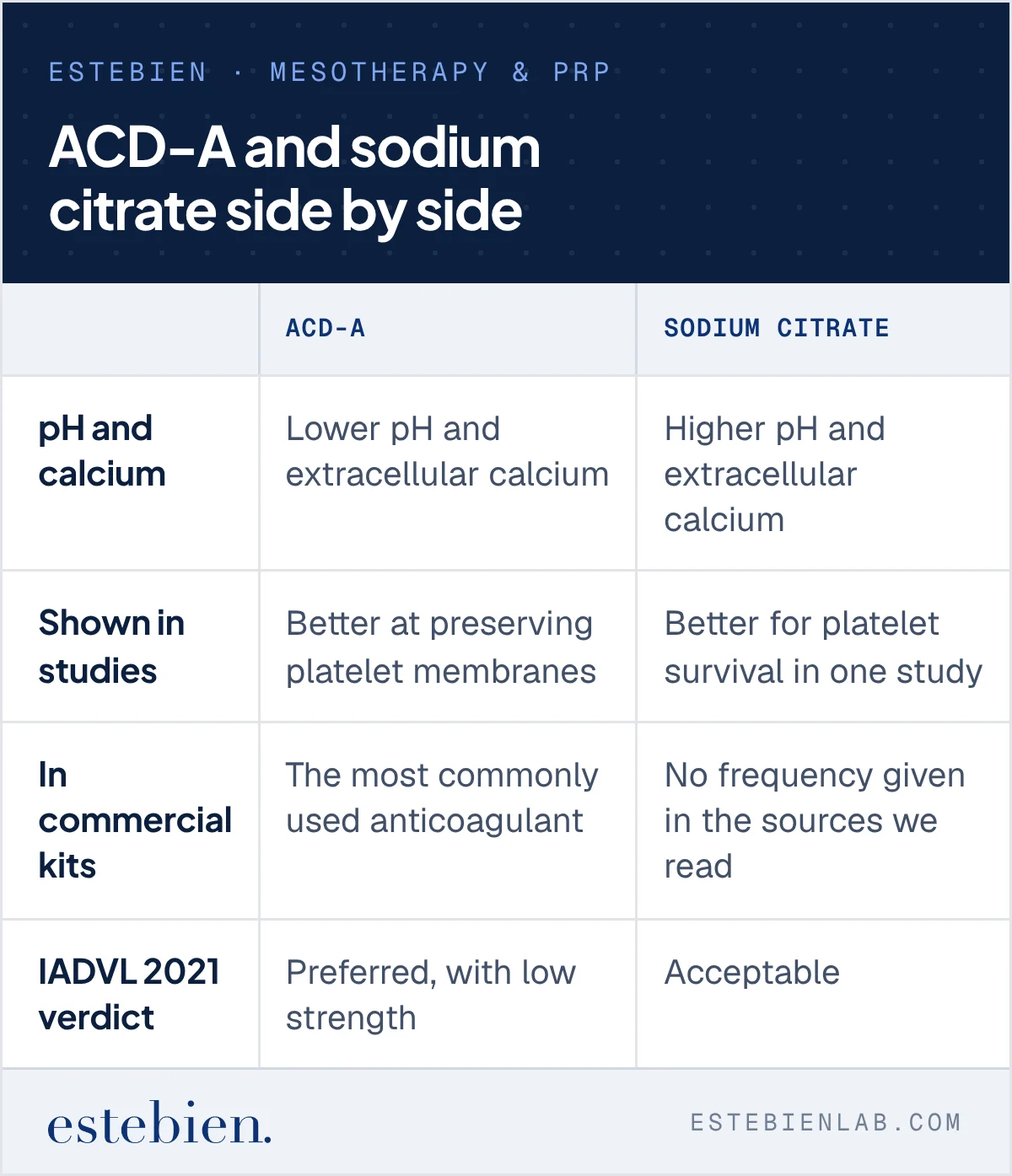
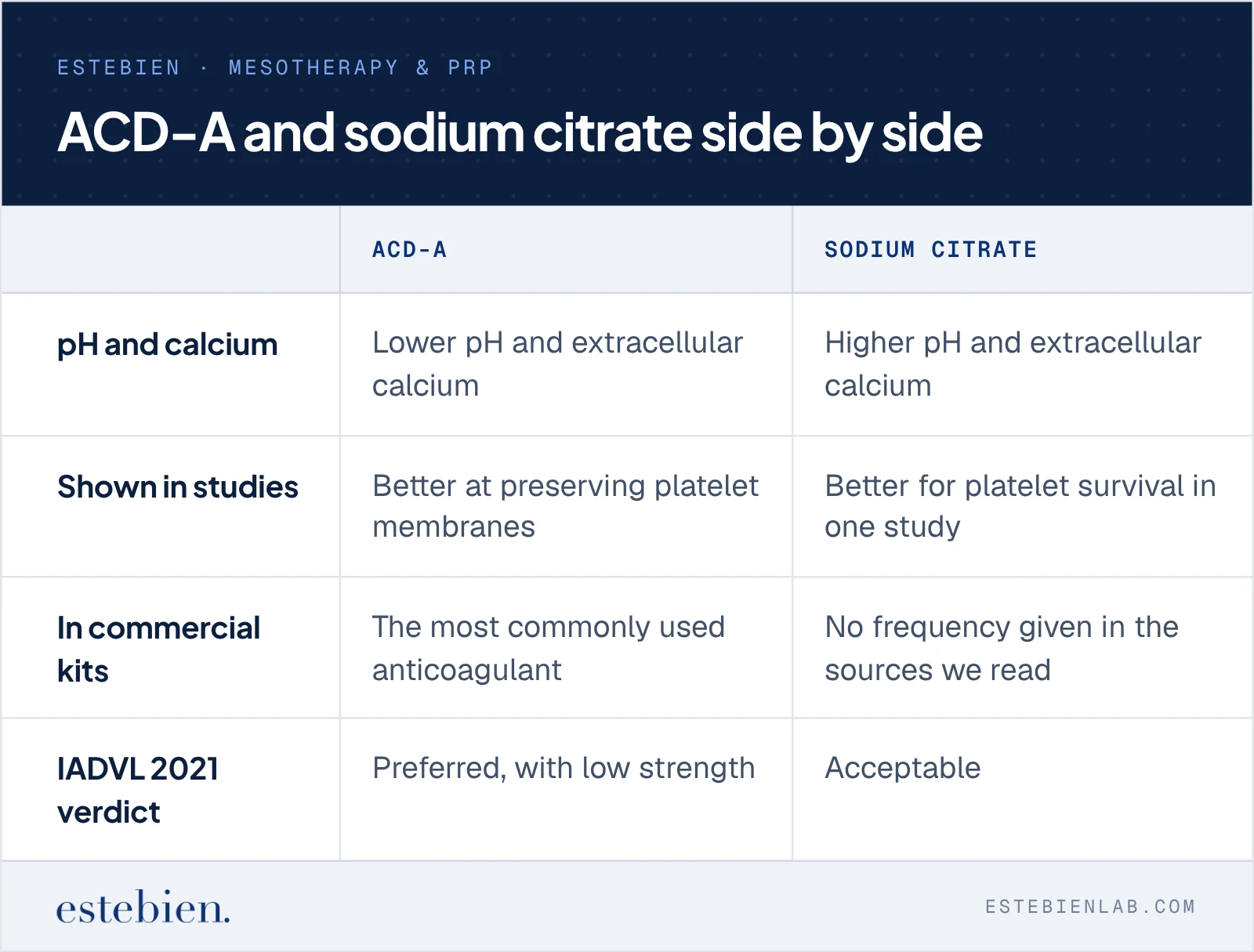
For other anticoagulants the sources are more cautious. A review published in EFORT Open Reviews in 2021 says EDTA is not recommended for PRP because it suppresses platelet degranulation, and that heparin can cause spontaneous platelet aggregation in some individuals. According to the same review, ACD-A is the anticoagulant most commonly used in commercial kits.
| Anticoagulant | What the sources say | Source |
|---|---|---|
| ACD-A | The preferred option; the most common in commercial kits | IADVL 2021, EFORT 2021 |
| Sodium citrate (3.2% or 3.8%) | Acceptable; better for platelet survival in one study | IADVL 2021 |
| CPDA | 10% less effective than ACD-A at maintaining platelet viability | IADVL 2021 |
| Heparin | Can cause spontaneous aggregation in some individuals | EFORT 2021 |
| EDTA | Damages the platelet membrane; not recommended for PRP | IADVL 2021, EFORT 2021 |
Gel tube or no gel?
In separator gel tubes, according to the IADVL recommendations, the tube contains 1-2 mL of a thixotropic polymer gel. The gel's specific gravity is lower than that of red and white blood cells and higher than that of platelets, so in the centrifuge it settles between the plasma and the other components. These tubes are easy to use and give an almost pure PRP; the document says this may suit the face and other cosmetic areas.
The debate is about platelet count. The IADVL reports that many studies found low platelet concentrations with gel kits, that in one comparison gel tubes cut the platelet count by 30%, and that gel-method PRP produced no significant hair growth in male pattern hair loss; heavier platelets may stay trapped below the gel. Adding a second spin outside the directions can raise the ratio, but according to the document this would void the kit's FDA approval.
Gel-free options include narrow-neck tubes and the manual double spin. In a comparison in the same document, the manual double spin concentrated platelets 4.8-fold and a commercial narrow-neck kit 2.8-fold. Judge a tube on the platelet yield its manufacturer reports, not on convenience alone.
Single spin or double spin?
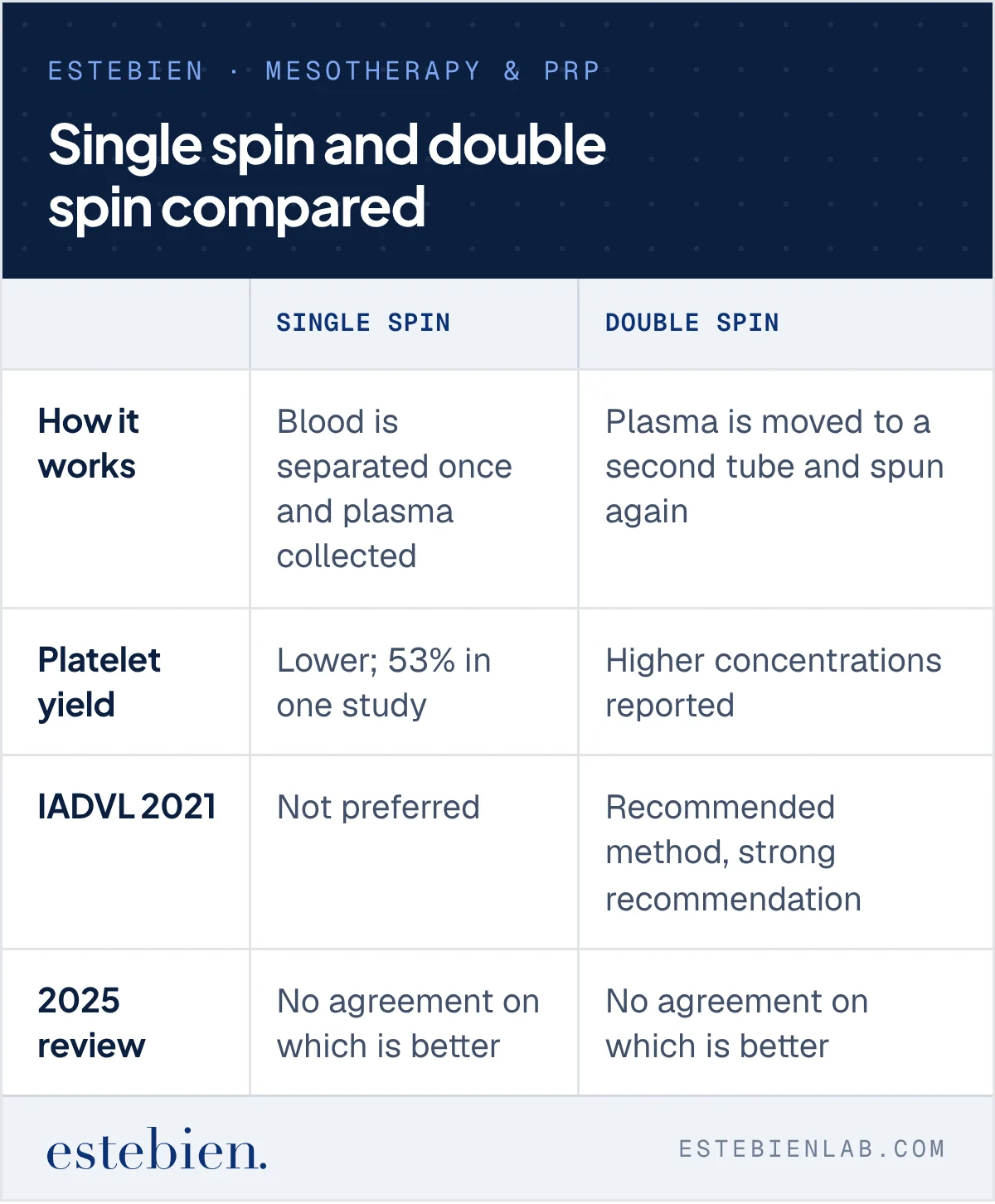
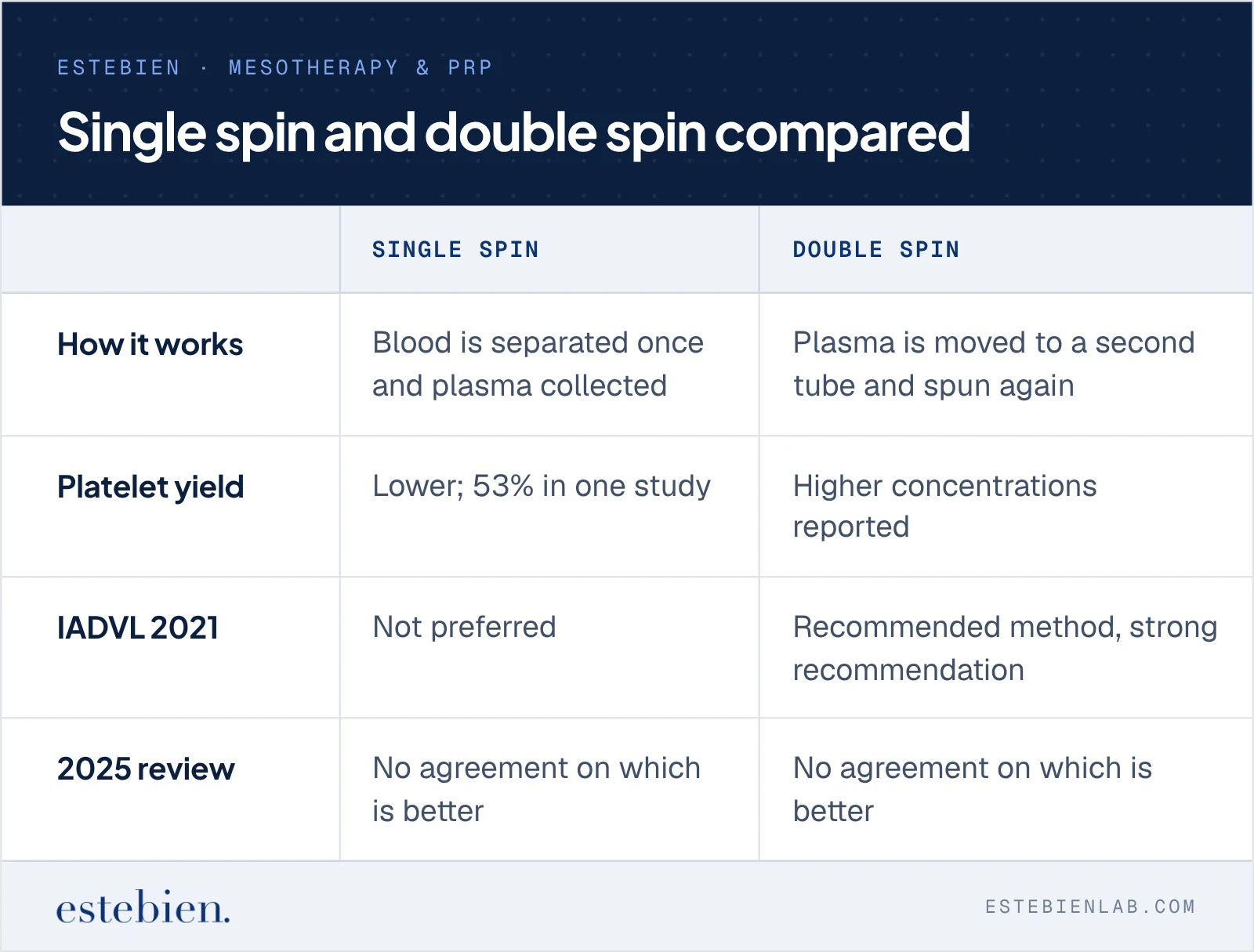
The IADVL recommendations name the double spin as the recommended method and grade the recommendation as high quality of evidence and strong. According to the document, single-spin methods give a lower platelet yield; in one study it cites, the yield was measured at 53%. The first spin sediments the heavy red blood cells, the supernatant is moved to a second tube, and a second spin at a higher force collects the platelets at the bottom.
The sources do not agree completely here. A 2025 systematic review of hair transplant studies says there is no clear agreement on whether a single or a double spin is more effective. The ISHRS likewise says the blood is processed with the protocol specific to the system in use, with a single or a double spin. In practice what counts is which protocol the tube was designed for and what results the manufacturer reports with it.
| Variable | IADVL recommendation | Note |
|---|---|---|
| First spin | 100-300 g, 5-10 minutes | Shorter at a higher force, longer at a lower force |
| Second spin | 400-700 g, 10-17 minutes | The recommendation text gives the upper limit as 750 g |
| Blood per tube | 3.5-10 mL | The range in the studies reviewed |
| Unit of force | Relative centrifugal force (g), not revolutions (RPM) | If no radius is given, the international standard is R-max |
| Activation | Not required for injection into soft tissue | Signs of activation reported at 800 g and above |
How are tube volume and blood volume worked out?
Tube volume determines how much PRP is obtained and how large an area can be treated. The ISHRS says the amount of blood depends on the system used and that generally at least 6 mL of PRP is available. The IADVL ties the calculation to three formulas:
- Platelet yield: (PRP volume × platelet concentration in the PRP) / (volume of blood drawn × platelet concentration in the blood).
- Platelet dose: PRP volume × platelet concentration in the PRP.
- Concentration factor: platelet concentration in the PRP / platelet concentration in the blood.
According to the document, platelet recovery is never 100%; studies give an average range of 50-80%. In the IADVL example, 5 mL of PRP concentrated 5-fold at 80% yield needs at least 31.25 mL of blood. A high concentration in a small volume may not cover the area, and a low concentration in enough volume may fall short of the intended level.
What does the literature say about platelet concentration, leukocytes and standardisation?
The sources give different figures for the target concentration. According to the ISHRS, the goal is to raise the platelet level 2-6 times above baseline, and there is no consensus on the ideal concentration. The IADVL recommendations suggest 1-1.5 million platelets per microlitre for dermatological use, but grade this as low quality of evidence, because no study has compared hair density directly across different platelet concentrations. The same document reports that very high concentrations had an inhibitory effect in cell studies.
Leukocyte content is the second big variable. According to the IADVL, transferring only the supernatant and the top of the buffy coat after the first spin gives pure PRP (P-PRP); transferring the whole buffy coat gives leukocyte-rich PRP (L-PRP). The EFORT review says the different PRP types have not been compared directly in any condition, and that the type of PRP used is often not stated in research.
Classification systems have been proposed to standardise PRP; the EFORT review notes that none has been validated by international consensus. In the DEPA-based comparison reported by the IADVL, methods giving a high platelet dose are not pure, and methods giving pure PRP mostly have a low yield. Expecting both the highest dose and the highest purity from one tube is not realistic.
| System | What it records | What it means for tube choice |
|---|---|---|
| PAW | Platelet concentration (P1-P4), exogenous activation and white cell and neutrophil levels | Ask the maker for platelet and white cell counts per microlitre |
| PLRA | Platelet count, white and red cell content, activation, volume injected | Ask whether red cell contamination was measured |
| DEPA | Injected dose, production efficiency, purity and activation | Judge yield and purity together |
| MARSPILL | Method, activation, red cells, number of spins, platelets, image guidance, leukocytes, light | Record whether the tube is for a single or a double spin |
What should you check on sterility, labelling and regulatory status?
The biggest risk to patient safety is how the blood is handled. The American Academy of Dermatology (AAD) says the blood must be kept sterile, otherwise an infection could develop, and that the facility should follow the process transfusion centres use so that each person receives only their own blood. With the open method, the IADVL treats aseptic precautions, preferably laminar airflow, a mask, sterile gloves and a gown as essential.
Regulatory status differs by country. According to the ISHRS, in the United States a device that prepares PRP must have FDA clearance, and centrifuges that separate blood for a medical purpose are medical devices. Several systems are FDA-cleared for orthopaedic indications, while use for hair is off-label. The IADVL stresses that these are 510(k) clearances for device safety, not approval for efficacy.
The sources we read say nothing about medical device classification in Turkey or the European Union. Ask the supplier in writing, for each product, for the CE marking, device class, declaration of conformity, sterilisation method, expiry date and storage conditions, and compare them with the packaging. A tube with damaged or opened packaging is not used.
What should you ask a supplier?
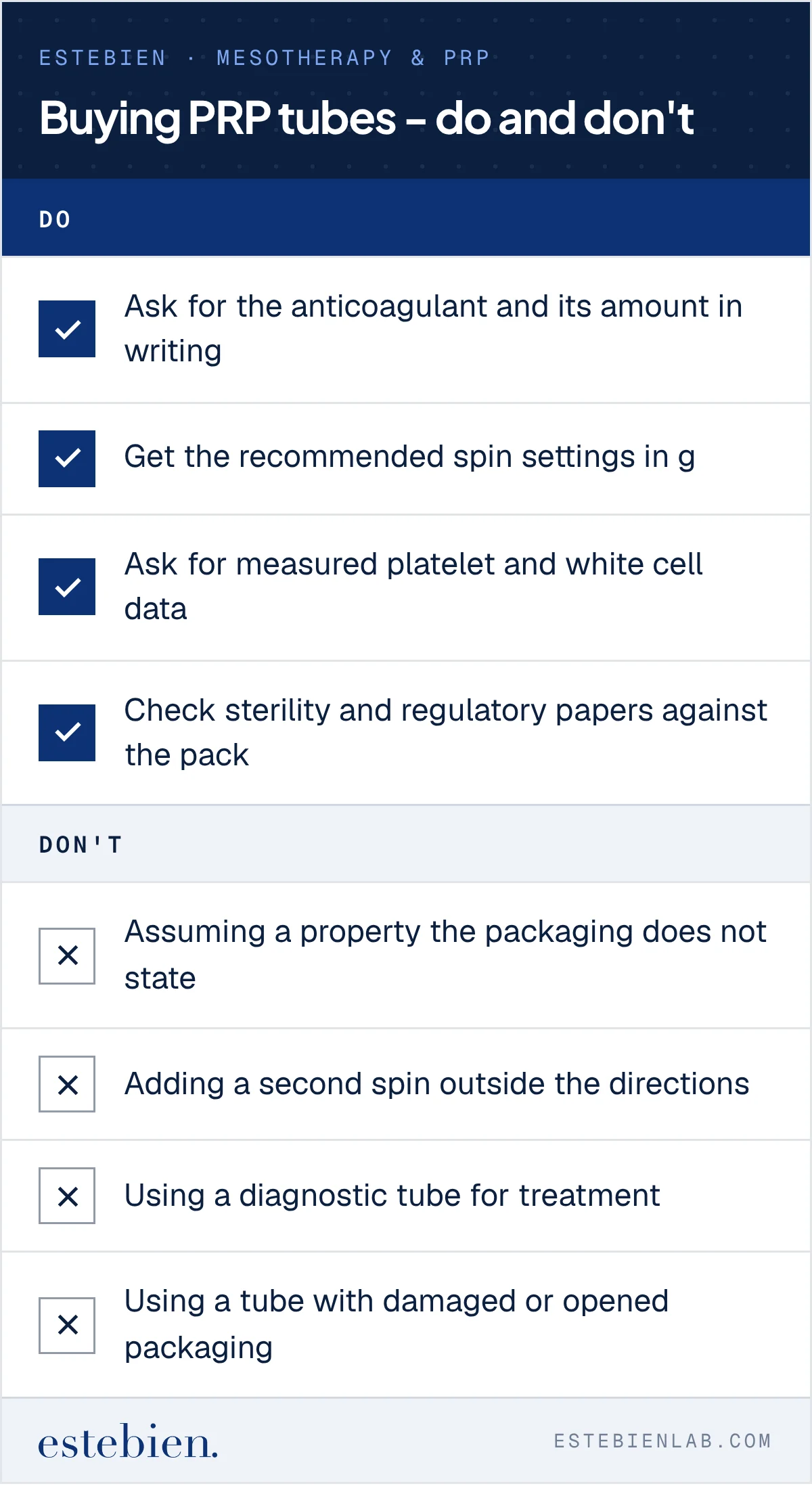
The questions below turn these variables into a purchasing conversation. Get the answers in writing.
- Was the tube made for preparing PRP, or for diagnostic blood collection?
- Which anticoagulant does it contain, and how much?
- Is there a separator gel, and if so, what data is there on platelet yield?
- What is the tube's volume and the recommended blood volume?
- Is it designed for a single or a double spin, and what are the recommended settings in g?
- Can platelet, white cell and red cell values measured with this protocol be shared?
- Is it glass or plastic, what is the sterilisation method, and was it tested for pyrogens and endotoxin?
- Which regulatory documents (CE marking, device class, declaration of conformity) come with it?
- Where on the packaging are the shelf life, storage conditions and batch number?
Patients often ask about the evidence: the findings for hair loss are in does PRP work for hair loss, use alongside surgery in PRP after a hair transplant, and aftercare advice in aftercare for PRP and mesotherapy.
What is known about the Estebien PRP Preparation Tube?
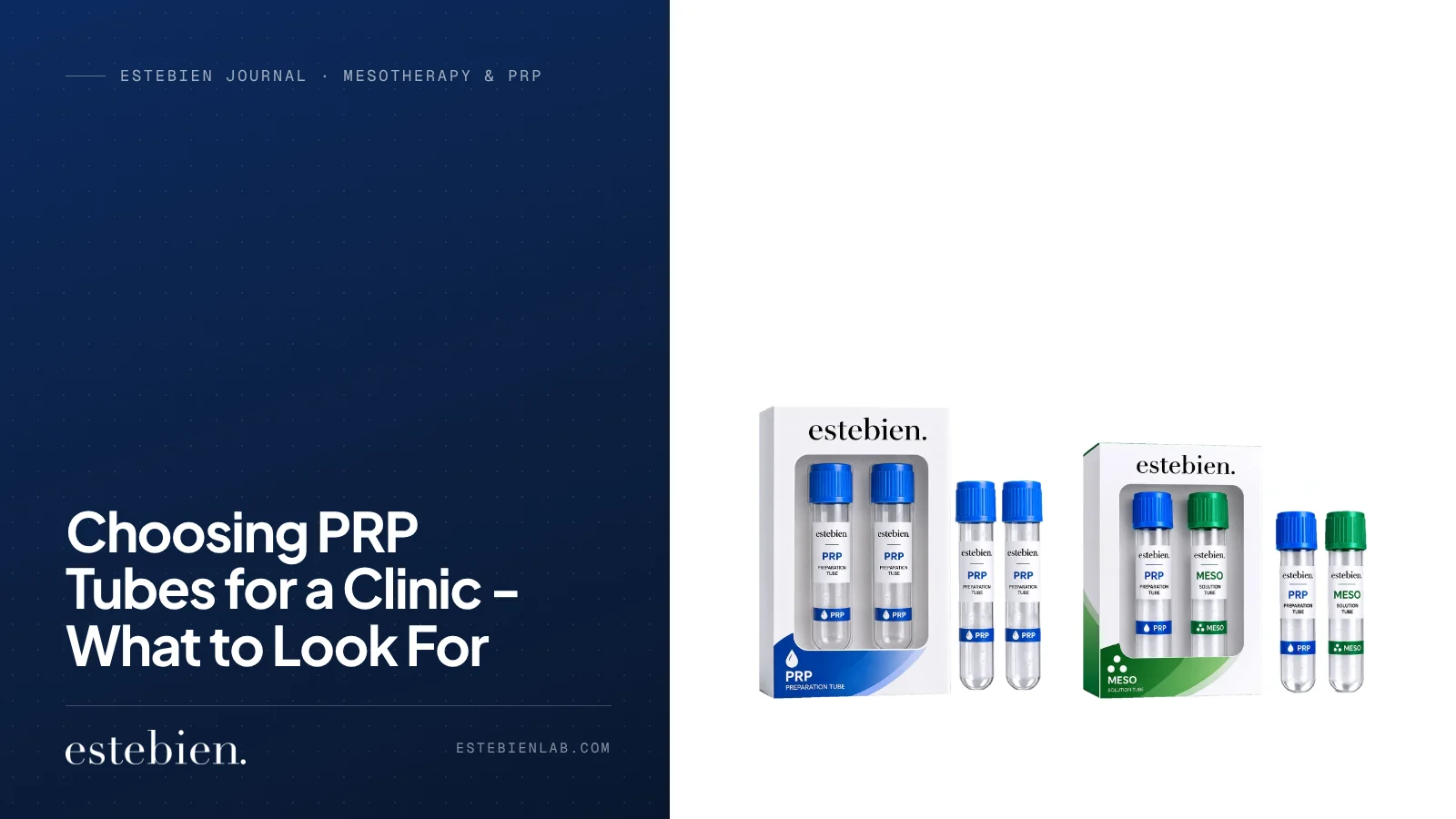
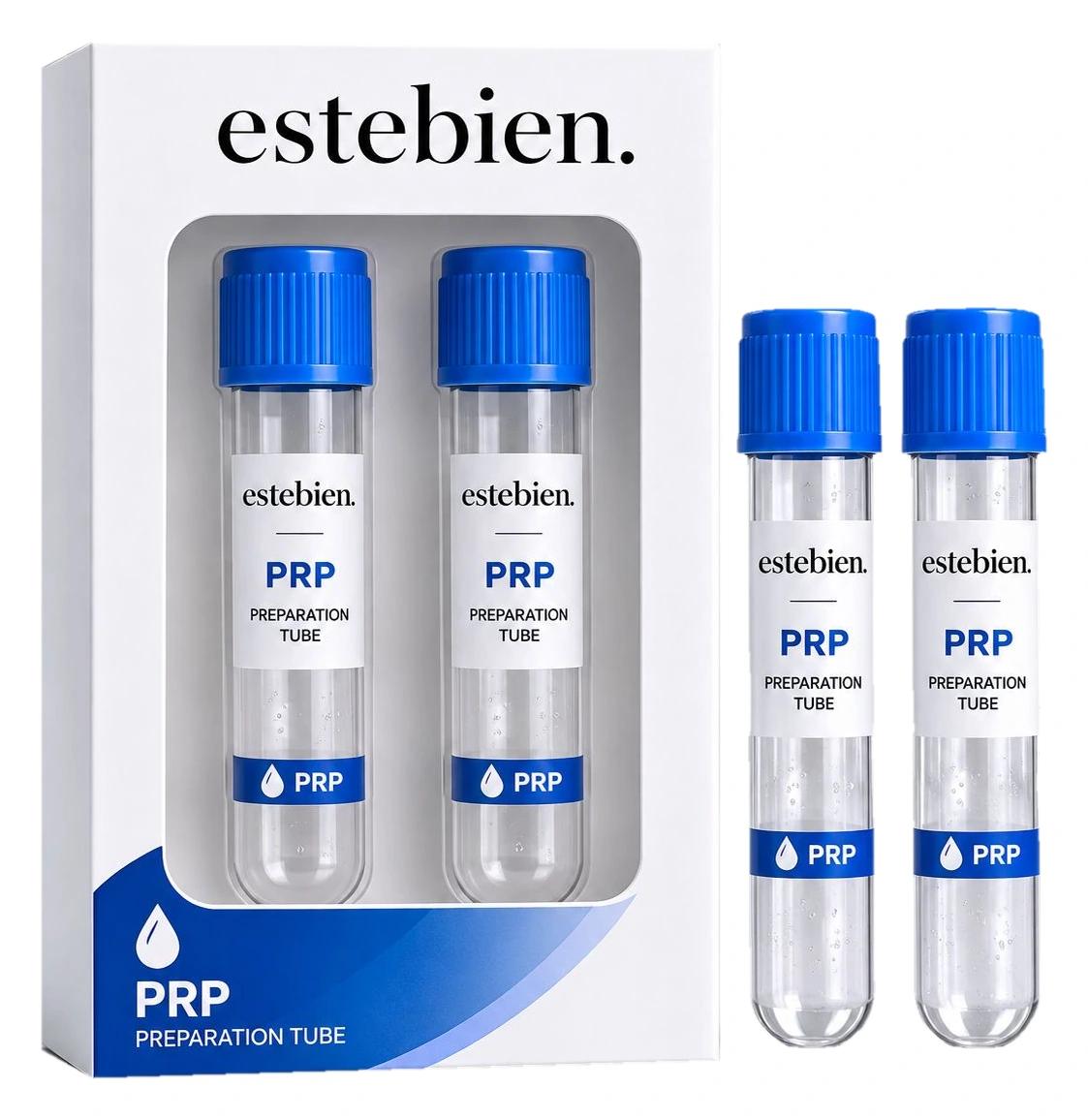
This section is for clinics and healthcare professionals. The Estebien PRP Preparation Tube box holds two blue-capped PRP Preparation Tubes. The product is for professional use only and is to be used only by qualified healthcare professionals, following the directions on the packaging. Directions for use, storage conditions and technical information are given on the packaging.
Estebien PRP Preparation TubeThe box contains two blue-capped PRP Preparation Tubes. Part of the Estebien Mesotherapy & PRP line; for professional use only.View product 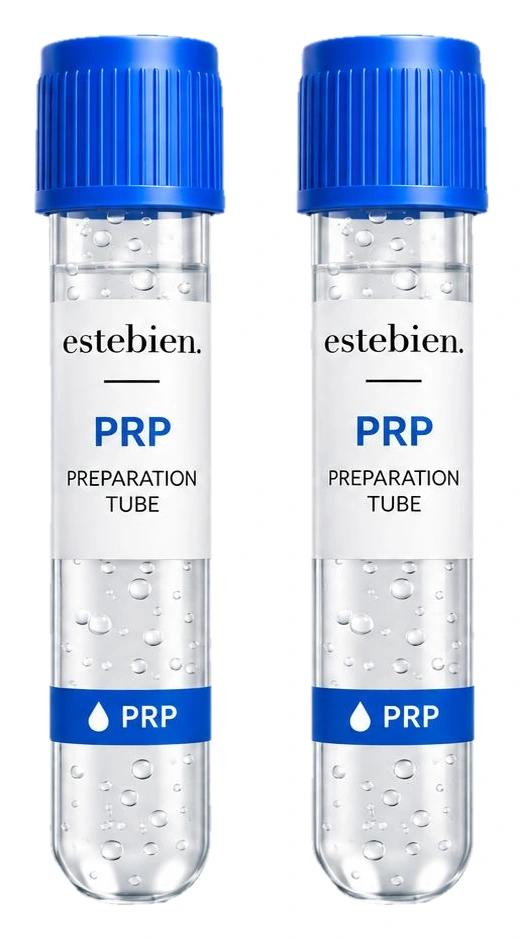
For technical details such as the tube's anticoagulant, volume, whether it contains a separator gel, its material, sterilisation method, recommended centrifuge protocol and documents, see the information on the packaging; for the questions in the checklist above, contact us from the product page. The product is offered on a quotation basis.
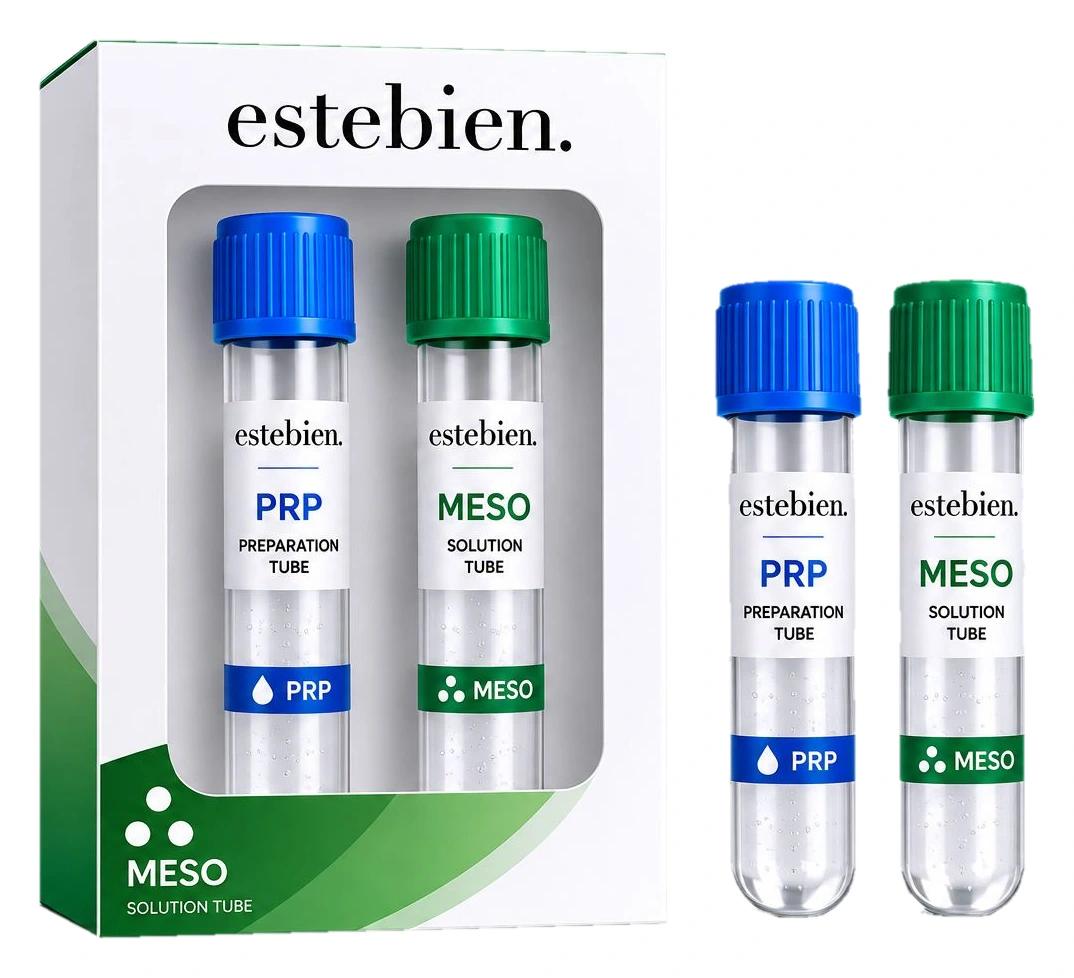
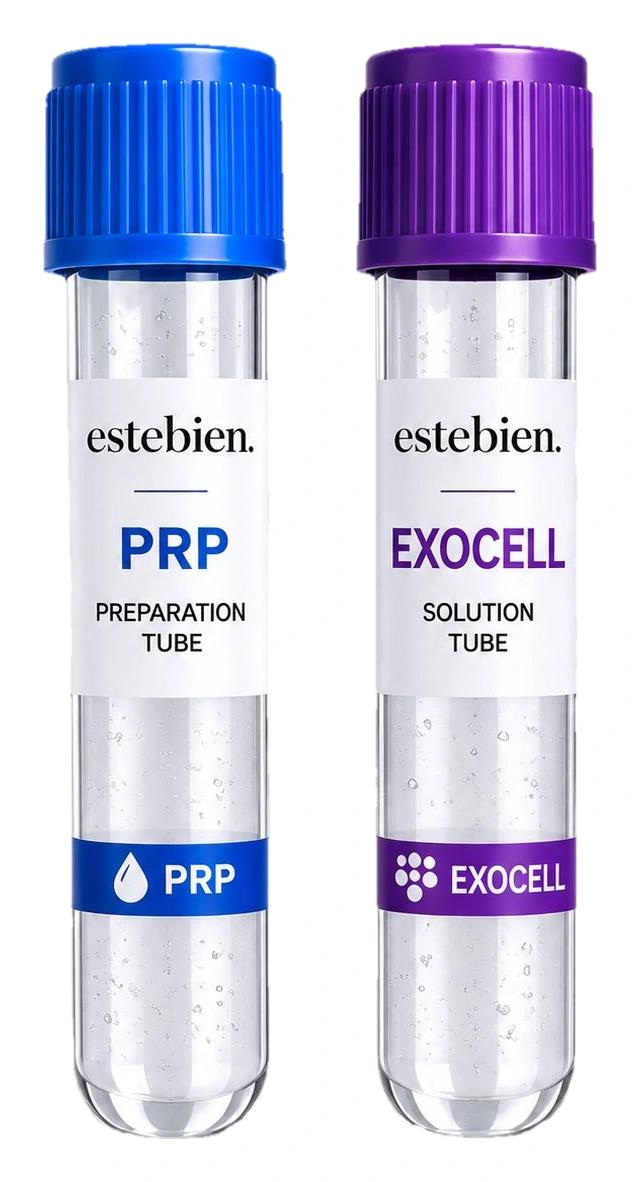
The PRP Preparation Tube is also in the line's other two boxes: the Meso Solution Tube box pairs it with a green-capped Meso Solution Tube, and the Exocell Solution Tube box with a purple-capped Exocell Solution Tube. The methods are compared in PRP or mesotherapy and our guide to exosome treatment for hair; all boxes are on the Mesotherapy & PRP line page.
Frequently Asked Questions
- Which anticoagulant should a PRP tube contain?
- The IADVL 2021 recommendations prefer ACD-A, but all the studies reviewed found both ACD-A and sodium citrate acceptable. EDTA is not recommended for PRP because it damages the platelet membrane.
- Are gel PRP tubes better?
- Gel tubes are easy to use and give almost pure PRP, but in studies cited by the IADVL the platelet concentration was often low. Which suits you depends on the platelet yield the manufacturer reports and on the procedure.
- How much blood is drawn for PRP?
- It depends on the system. The studies reviewed by the IADVL used 3.5-10 mL of blood per tube; in the document's example, 5 mL of PRP concentrated 5-fold needs at least 31.25 mL of blood.
- What is the ideal platelet concentration for PRP?
- There is no consensus. The ISHRS says the aim is a 2-6-fold increase over baseline; the IADVL suggests 1-1.5 million platelets per microlitre for dermatology and grades this as low quality of evidence.
- Are PRP preparation systems approved?
- According to the ISHRS, several systems are FDA-cleared in the United States for orthopaedic indications and use for hair is off-label; these clearances concern device safety, not efficacy. Ask the supplier in writing about the status in your country.
- Which anticoagulant is in the Estebien PRP Preparation Tube?
- Technical information such as the anticoagulant, volume and gel is on the packaging; contact us from the product page for details.
- Can PRP tubes be used at home?
- No. The Estebien PRP Preparation Tube is for professional use only and is to be used only by qualified healthcare professionals, following the directions on the packaging.
Sources
- Preparation of Platelet-Rich Plasma: National IADVL PRP Taskforce RecommendationsIndian Dermatology Online Journal (PubMed Central)
- Platelet-rich plasma: a narrative reviewEFORT Open Reviews (PubMed Central)
- Efficacy of Platelet-Rich Plasma as an Adjunct to Hair Transplantation: A Systematic ReviewCureus (PubMed Central)
- PRP for Hair Loss: Procedure, Benefits & CostsInternational Society of Hair Restoration Surgery (ISHRS)
- Platelet-Rich Plasma in Hair TransplantationInternational Society of Hair Restoration Surgery (ISHRS)
- Is platelet-rich plasma the secret to younger-looking skin?American Academy of Dermatology (AAD)
This article is for general information only and is not a substitute for medical advice. For decisions about your health, consult your doctor or dentist.
Products in this article